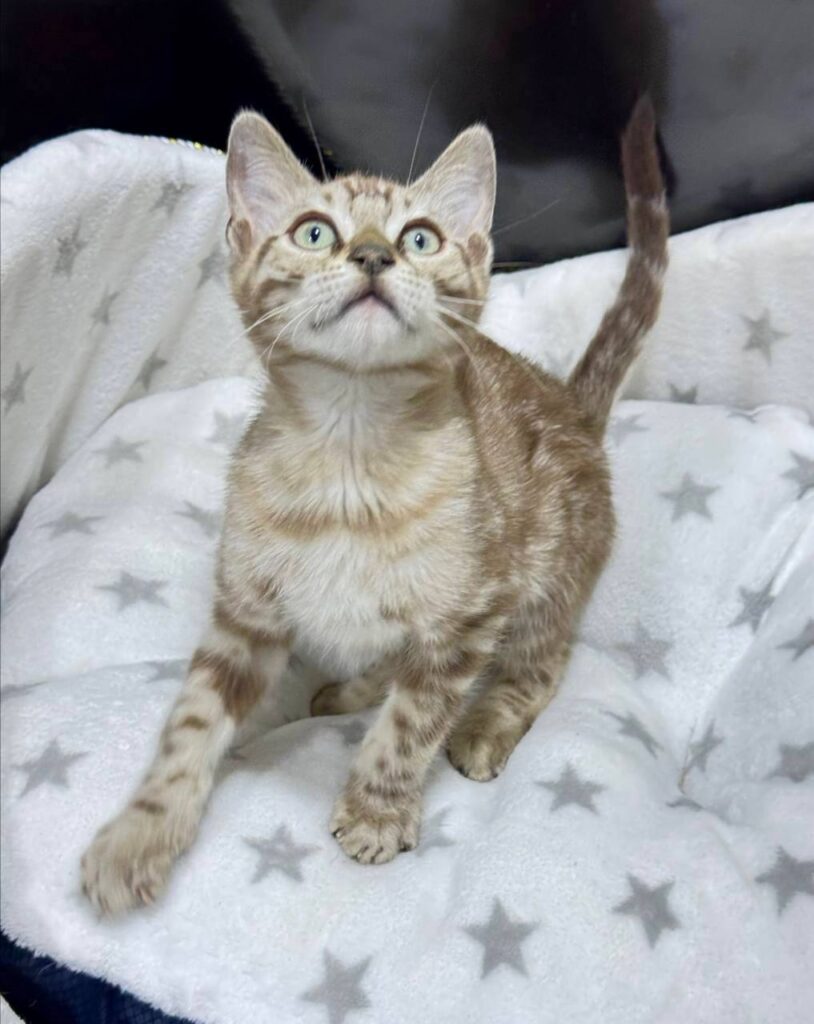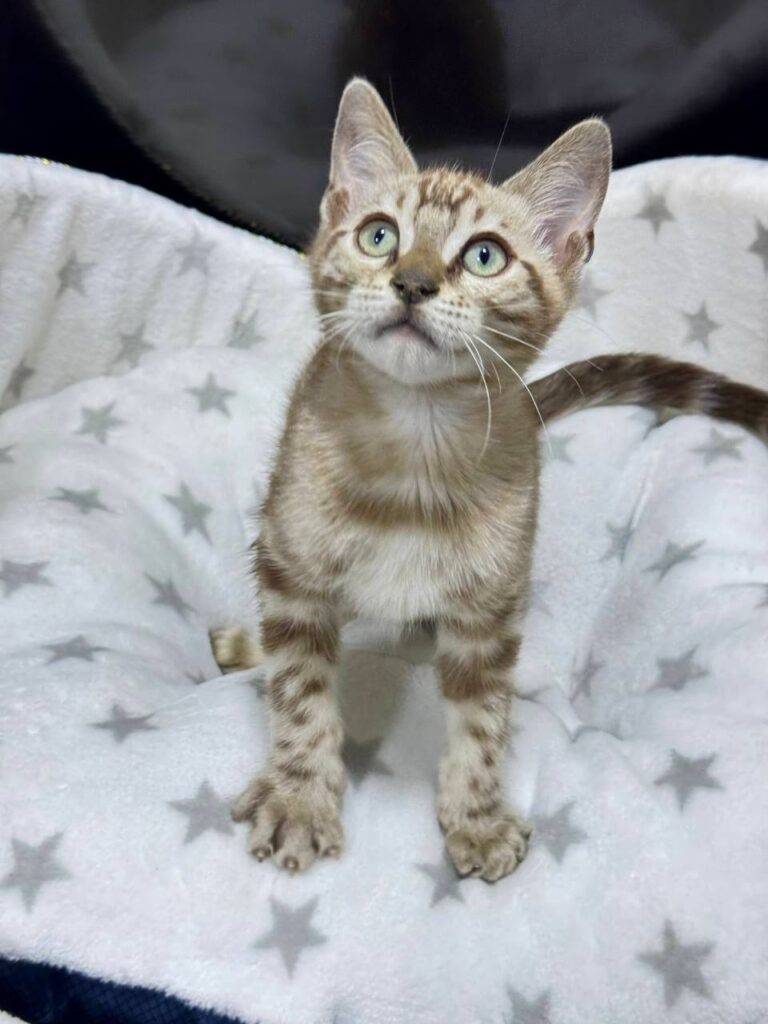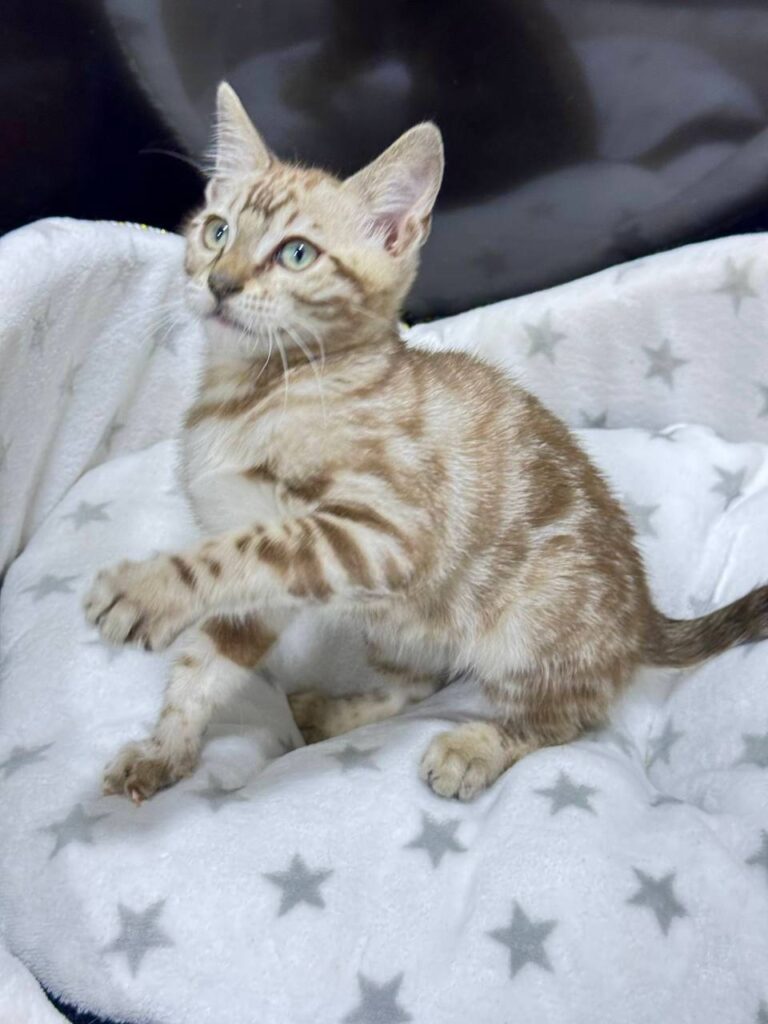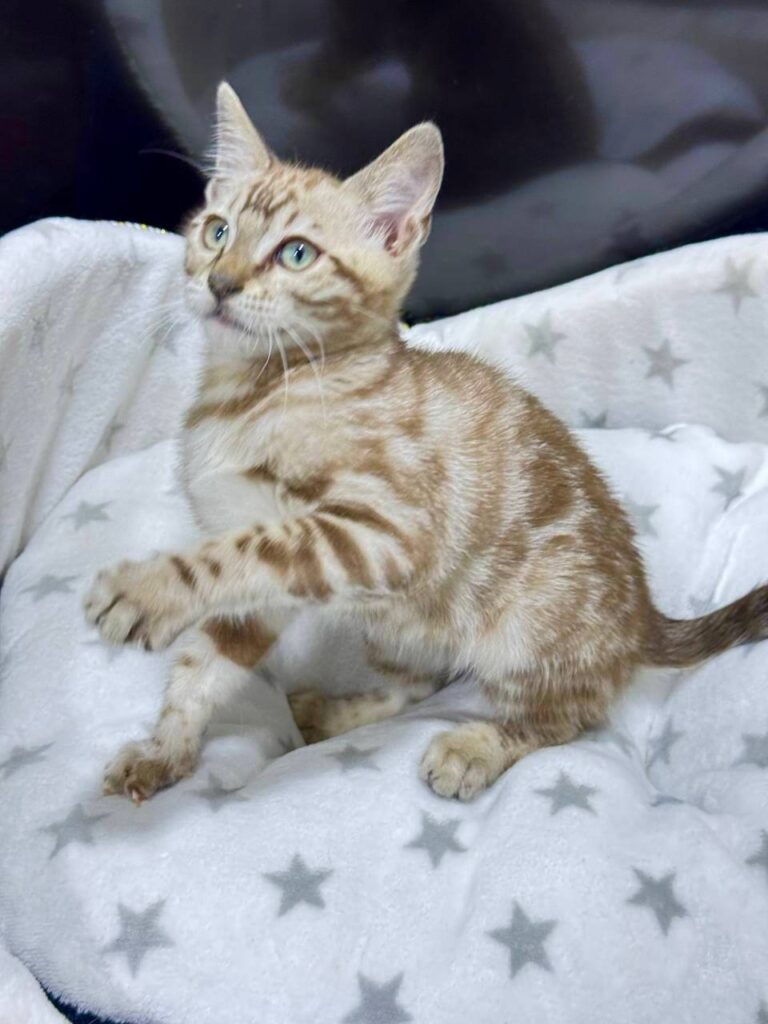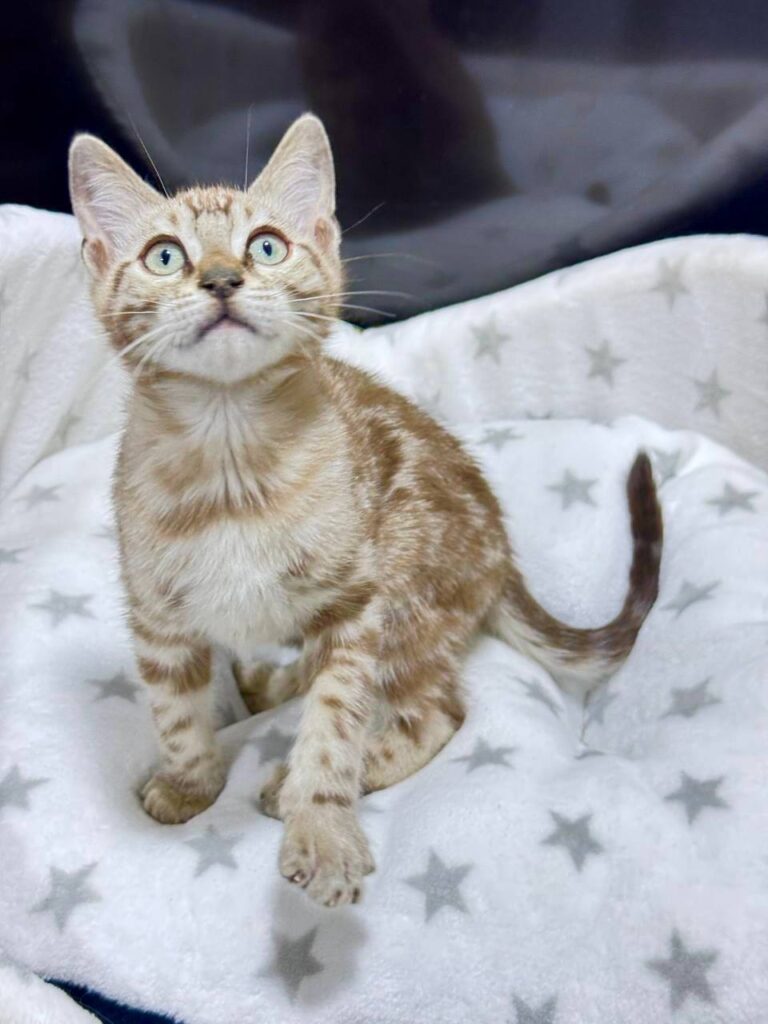
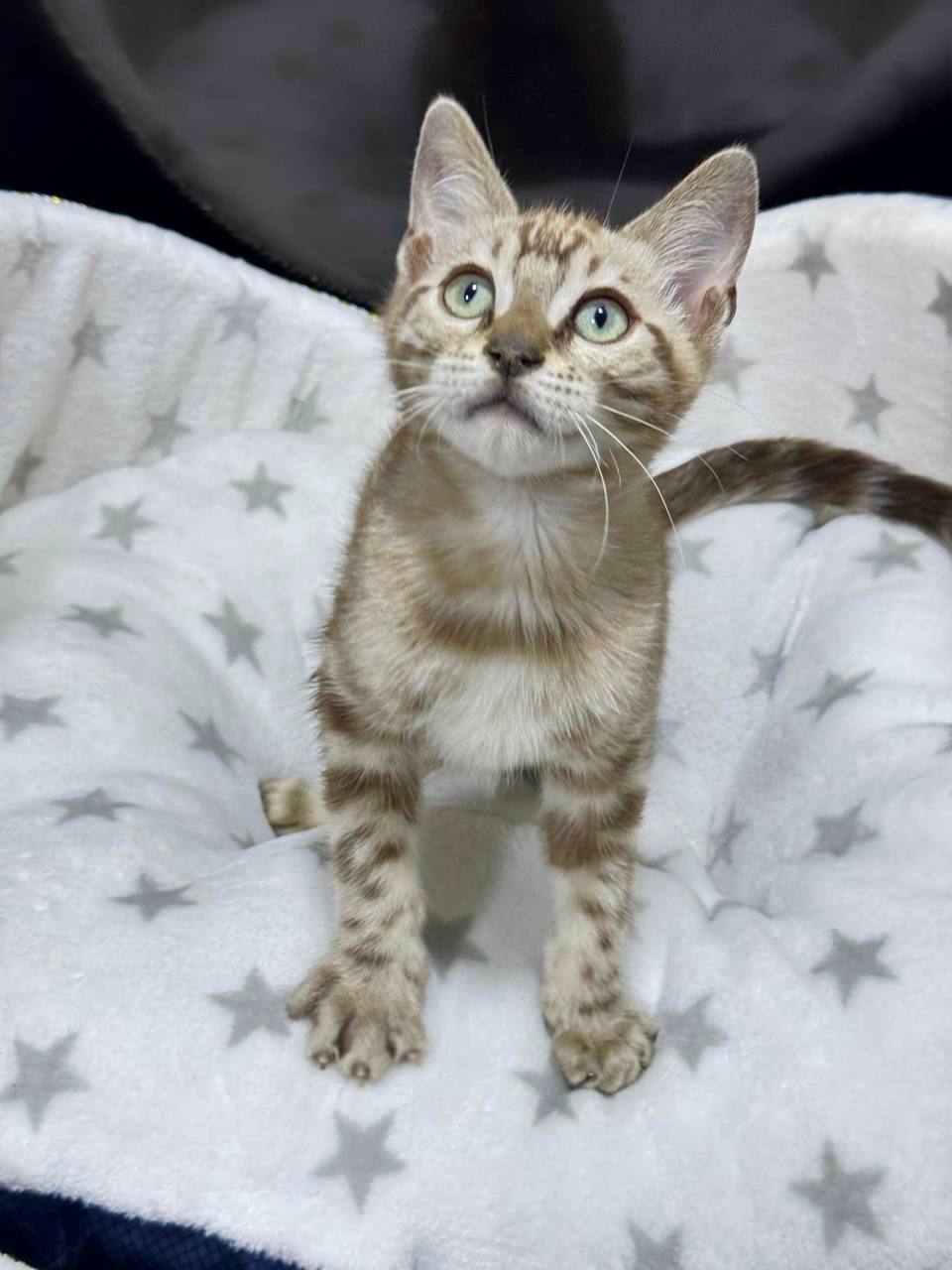
SOLD – When one thinks of the pinnacle of domestic feline beauty, the Bengal often tops the list. Among these miniature leopards, some individuals stand out not just for their lineage, but for their specific aesthetic and health preparation. Enter Lucky, a 2.5-month-old male mink Bengal. Lucky represents a unique intersection of wild aesthetics and domestic companionship, characterized by his rare “mink” coat and his comprehensive early-life medical care.
The Heritage of the Bengal
To understand what makes Lucky so special, one must first look at the history of the Bengal breed. Developed by crossing domestic felines with the Asian Leopard Cat (Prionailurus bengalensis), the Bengal was bred to possess the exotic markings of a jungle cat while maintaining the temperament of a household pet. While some breeds like the Abyssinian or the Egyptian Mau also possess ancient or exotic looks, the Bengal is unique in its direct wild ancestry, which contributes to its high energy and incredible intelligence.
Lucky’s Rare Mink Coloration
Lucky is not a standard brown spotted Bengal. He is a “mink” Bengal. In the world of feline genetics, the mink coloration is a result of inheriting one Burmese “sepia” gene and one Siamese “pointed” gene. This gives Lucky a coat that is richer and darker than a “snow” Bengal, but softer and more cream-toned than a traditional brown Bengal.
The mink variety is highly sought after because of the “aqua” eye color it produces—a stunning blue-green that glows with intensity. Unlike the Siamese, which has deep blue eyes, or the Burmese, which typically has gold eyes, Lucky’s mink heritage provides a middle ground that is visually arresting. His coat is also famously soft, often described as having a “glitter” effect, where the tips of the hair shafts are translucent and reflect light, making it look as though he has been dusted with gold or silver flakes.
The Importance of the 2.5-Month Milestone
Lucky is currently 2.5 months old, which is approximately 10 to 11 weeks. This is a critical developmental window for any Bengal. At this age, kittens are transitioning from their mother’s milk to solid food and are learning the “social graces” of being a cat. They learn “bite inhibition” through play with their littermates. Compared to more sedentary breeds like the Persian or the British Shorthair, a Bengal kitten at 2.5 months is a whirlwind of activity. They are beginning to test their jumping abilities and exploring the vertical space of their environment.
Health and Vitality: Microchipped, Dewormed, and Vaccinated
One of the most significant aspects of Lucky’s profile is his health status. Responsible Bengal ownership begins with a foundation of preventative medicine. Lucky has already been microchipped, which is an essential safety net. Because Bengals are highly curious and active, they are more prone to “escapades” than a Ragdoll might be. A microchip ensures that if Lucky ever wanders too far, he can be reunited with his family.
Furthermore, Lucky has been dewormed and vaccinated. Kittens are susceptible to internal parasites and various feline viruses like FVRCP (Feline Viral Rhinotracheitis, Calicivirus, and Panleukopenia). By ensuring these medical steps are completed by 2.5 months, Lucky’s immune system is robustly prepared for his new home. This is particularly important for high-energy breeds like the Savannah or the Bengal, as their active lifestyles require a healthy physical foundation.
What to Expect from a Bengal Like Lucky
Prospective owners often compare the Bengal to other intelligent breeds like the Burmese or the Oriental Shorthair. However, Lucky will likely exhibit behaviors that are quintessentially Bengal. This includes a fascination with water—don’t be surprised if he tries to join you in the shower—and a need for “environmental enrichment.”
Living with Lucky means providing him with tall scratching posts, interactive puzzles, and perhaps even a cat exercise wheel. Unlike the Maine Coon, which might be content to lounge on the sofa after a short play session, Lucky’s Bengal bloodline means he will have bursts of “zoomies” that require engagement. He is a male, and male Bengals are often known for being particularly affectionate and bond closely with their primary caregivers.
Conclusion
Lucky is more than just a pet; he is a genetically beautiful and well-cared-for example of the Bengal breed. With his mink coat, aqua eyes, and the energetic spirit of a 2.5-month-old kitten, he represents the best of what this breed has to offer. Because he is already vaccinated, dewormed, and microchipped, Lucky is ready to transition into a forever home where his intelligence and striking appearance will be appreciated for years to come. Whether you are a fan of the Sphynx for its uniqueness or the Russian Blue for its elegance, the mink Bengal offers a combination of exotic flair and playful companionship that is truly unmatched.